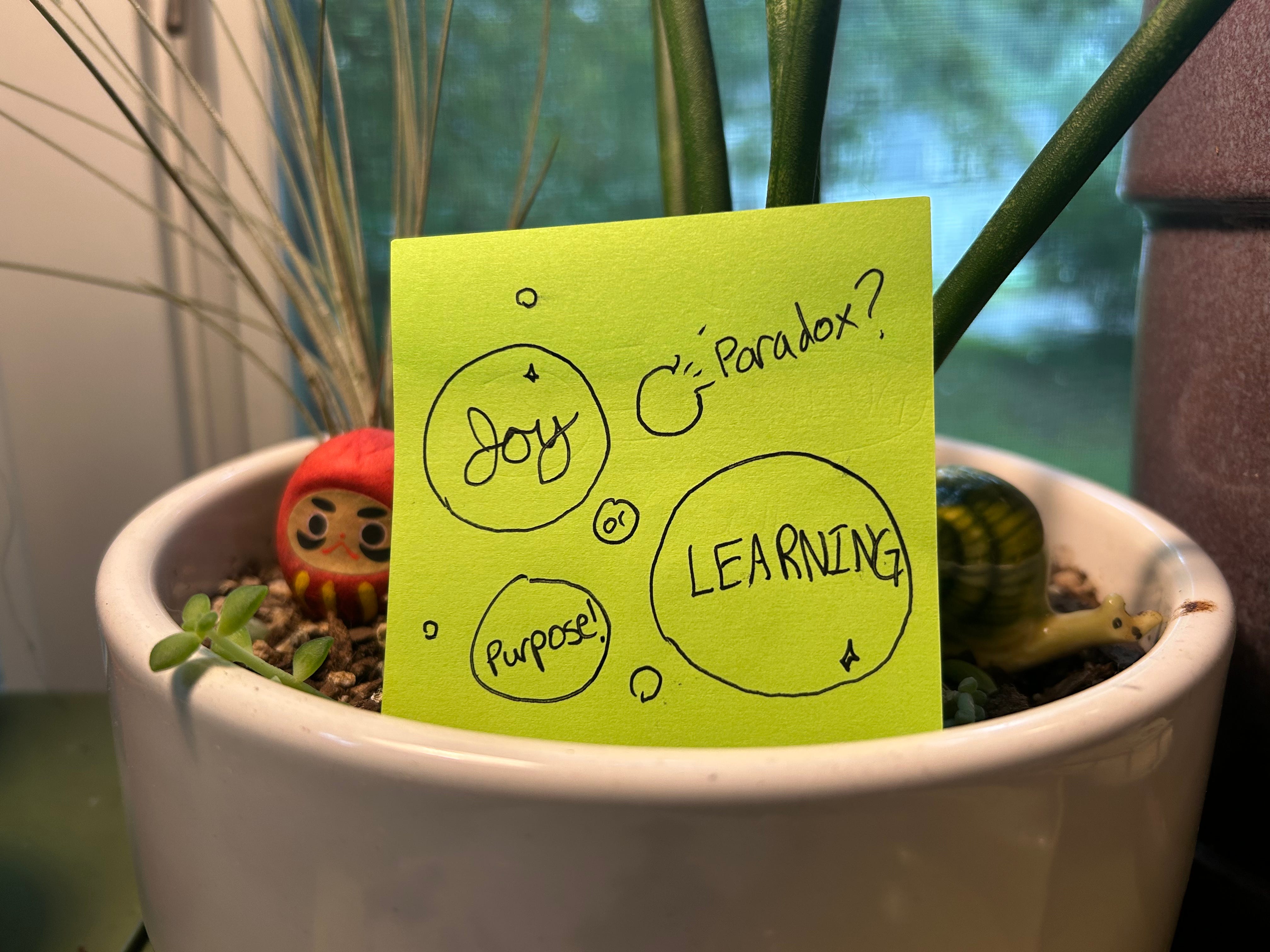
Paradox or Purpose?
what bubbles up when joy and learning collide
This morning, I was listening to a great podcast episode of an interview with John Hattie by a friend and colleague, Olivia Wahl. It was incredible for many reasons, including the deep exploration of how teachers build expertise through “evaluative thinking”. Please go take a listen!
But this post is about one particular moment in their conversation that got me thinking. In the conversation, Olivia was talking about strategies for supporting joyful learning, and John Hattie remarked that “learning is not always enjoyable”. They were talking, of course, of how learning requires struggle and that struggle is not generally comfortable, but if we are intrinsically motivated to learn, we are willing to engage in struggle.
This got me wondering about what people generally mean when they say “joyful learning”. It got me wondering about what I mean when I say that. As someone who makes sense of ideas through visual thinking and the natural world, I considered the seeming paradox of the words “joy” and “learning” with the image above. As a word nerd, I also looked up both words. Here is the dictionary definition for learning:
So the learning definition is not all that helpful, as someone who has spent more than 20 years obsessed with how humans learn, this definition leaves a lot to be desired. But one thing most of us know is that learning something new is not always easy. So on its face, learning seems to live in paradox with joy. If learning is hard, how can it be joyful? Isn’t joy fun and easy? Well, let’s look at that definition next:
Again, it is difficult to capture a complex idea or experience like “joy” in a definition; however, it struck me that the first definition of joy includes the experience of “success” and “the prospect of possessing what one desires”. In the podcast above, I think Hattie was speaking to learning’s relationship with the second definition more than the first. And if you think about it that way, then yes, “joy” and “learning” seem to be in paradox with one another. But what happens if you operate from the first definition of joy?
Well, I think that is where you land is purpose. When we operate from a sense of purpose to drive our learning, this leads directly to joy at the “prospect of possessing” and succeeding in knowing or being able to do something aligned with your purpose. Hattie’s work definitely centers the importance of intrinsic motivation, but Gholdy Muhhamed’s work directly addresses the relationship between joy and learning:
“Joyful Learning emphasizes the transformative power of joy in education, positing that joy is not merely a byproduct of learning but a means for making the world a better and more equitable place. In her work, Dr. Gholdy Mohammed has studied how joy serves as a powerful catalyst for learning, creativity, and justice. She argues that joy is not just nice to have, but necessary (Muhammad, 2023).”
If you know me at all, you probably know where I am going next. So what does the natural world have to teach us about this relationship between joy and learning? For me, this is most present when I think about bubbles in nature. Stay with me here. As a poet, I often think and make sense of the world through metaphors. There is a ton of research on how mental models and metaphors shape thinking and action (future post). But for me, bubbles are the perfect metaphor for joy and learning. I wrote about this a while back in this blog post. However, recently I have been really thinking about what we can learn from bubbles that helps us design learning that is both rigorous & joyful. Here are some visuals I created to help us move our mental models of joy and learning from the factory mental model of either/or, to a forst mental model that insists both/and:
So what do you think? Where have you seen joy and learning living together with rigor and productive struggle? I would love to hear some stories from your lives of joyful learning that fit with the definition of joy as an emotion we experience when we strive to learn something purposefully.1
If you enjoyed this read, consider subscribing or sharing this post with someone. Also, please check out the podcast that inspired this reflection, Schoolutions by Olivia Wahl. Here is the episode with John Hattie, and here is my episode where Olivia and I had a wonderful conversation about moving learning from the factory using Wild Design.
Curious about Wild Design. Check out my website and consider joining social impact leaders for a Wild Design workshop with me and Paul Kim on Nov. 14-15 or Dec. 12-13 in Denver, CO, at the REDI Lab.
Please excuse any mistakes or typos. I try to avoid using too much AI in my work because I want to keep creativity and voice thriving in my writing. This means I probably messed something up, but I know you will forgive me.


Great piece..thank you. I have found joy and struggle pair together when purpose is clear. If you know what you are doing, why you are doing it and you have experienced the payoff of learning something hard there can be joy right next to or right after struggle.
I love this! And I think that there can certainly be a good dose of enjoyment to be found in struggle. I often thrive in spaces that push me to a limit. I love spaces that “dunk me underwater… see how long I can hold my breath!”
And that has to happen with requisite trust that the person dunking me will sense when I’m about to go under, will pull me out and also knows CPR. :)
So I love this notion of joyful learning. How do humans learn best? Just watch a 6yo for 10 minutes.
Play. Not without frustration and struggle.